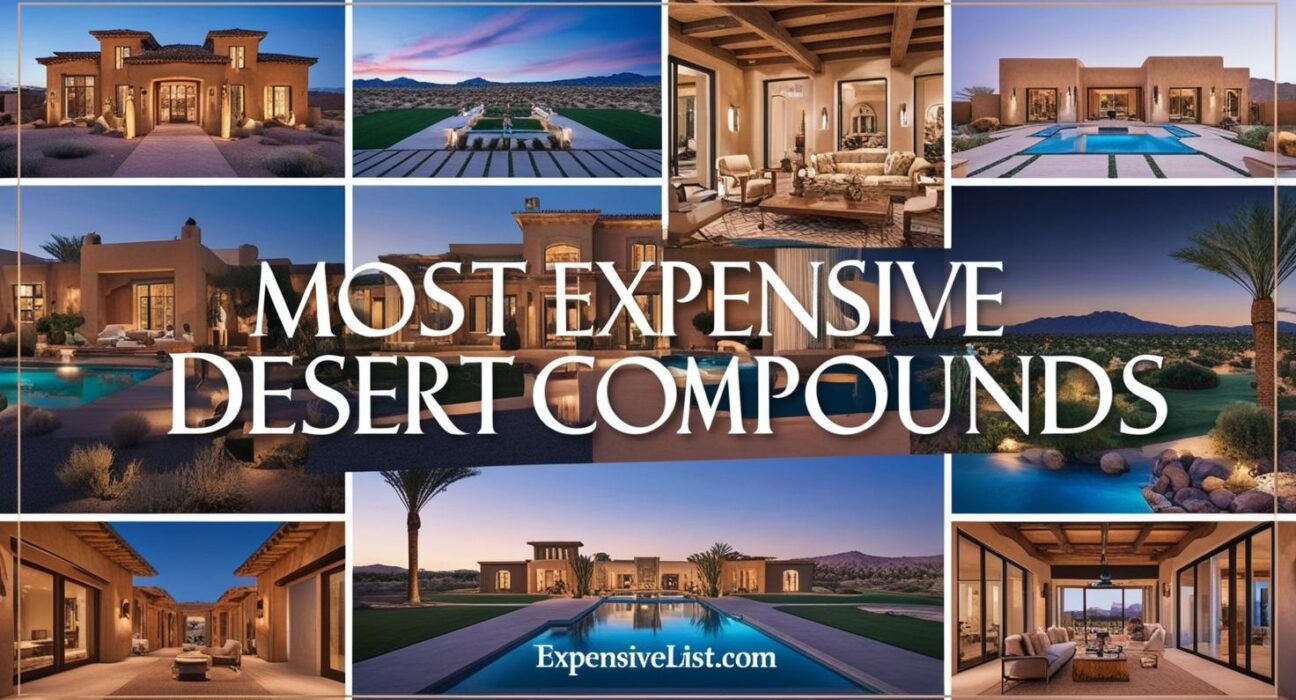
What happens when the world’s wealthiest individuals want to disappear? They build private desert empires—hidden oases where luxury thrives in the most inhospitable environments. These aren’t just vacation homes; they’re self-contained kingdoms with private airstrips, underground bunkers, and water sources worth millions.
From Dubai’s golden sand palaces to Arizona’s clandestine billionaire bunkers, these ultra-exclusive compounds offer unmatched privacy, extreme security, and unimaginable extravagance. For those who can afford them, they’re the ultimate escape from prying eyes—and the ultimate flex in discreet wealth.
Here, we reveal the most expensive desert compounds in the world, where money transforms barren landscapes into private paradises.
1. “The Mirage” – Dubai’s $500M Invisible Desert Palace
A Mirage of Glass & Gold in the Empty Quarter
Built by a Middle Eastern royal, this optical illusion mansion appears to vanish into the dunes thanks to reflective nano-glass. Beneath its stealthy exterior lies 100,000 sq ft of pure luxury.
What Makes It So Expensive?
- $75M climate-control system: Maintains 72°F year-round in 120°F heat.
- Private desalination plant: Converts 10,000 gallons/day of drinking water.
- Underground car gallery: Stores 30+ hypercars in desert-proof conditions.
- Rarity: Only one exists—custom-built for absolute discretion.
Where to Find It: Off-market; rumored to be listed on Dubai Secret Estates.
Image Prompt: A futuristic, glass-walled mansion seemingly floating above the dunes, with a shimmering infinity pool blending into the horizon.
2. “The Scorpion Ranch” – Arizona’s $320M Doomsday Retreat
Where Silicon Valley Titans Prep for the Apocalypse
Owned by a tech billionaire, this 2,000-acre fortress is designed to withstand EMP attacks, pandemics, and societal collapse—with style.
What Makes It So Expensive?
- $40M underground bunker: 30-ft-deep, with 5 years of supplies.
- Private airstrip & drone defense system: For secure arrivals.
- On-site crypto mine: Powers the compound and generates income.
- Cultural significance: A blueprint for elite survivalism.
Where to Find It: Occasionally listed via Ultra Private Homes.
Image Prompt: A rugged desert compound with a hidden entrance, solar-paneled rooftops, and a private runway lined with armored SUVs.
3. “The Al Ula Oasis” – Saudi Arabia’s $450M Ancient-Modern Hybrid
A Billionaire’s Playground Among 2,000-Year-Old Ruins
Nestled in a UNESCO-protected valley, this futuristic estate blends ancient Nabatean architecture with space-age tech.
What Makes It So Expensive?
- $60M water-from-air harvesters: Pull 3,000 gallons/day from desert winds.
- Private archeological site: Includes Roman-era tombs on the property.
- Gold-leafed domes: Hand-applied by master Moroccan artisans.
- Exclusivity: Only 3 guests/year allowed by Saudi royalty.
Where to Find It: Bespoke inquiries through Kingdom Real Estate.
Image Prompt: A golden-domed mansion carved into sandstone cliffs, with LED-lit palm groves contrasting against ancient rock carvings.
4. “The Joshua Tree Quantum House” – California’s $280M AI-Run Sanctuary
Where Tech and Tranquility Collide
This off-grid smart compound uses quantum computing to optimize everything from sunlight angles to cocktail temperatures.
What Makes It So Expensive?
- $35M AI “mind”: Learns owner’s habits down to pillow firmness.
- Holographic desert garden: Projects 360° virtual landscapes.
- Tesla Tunnel access: Secret 7-mile underground route to LA.
- Status symbol: Owned by a FAANG founder.
Where to Find It: Rarely listed; last sold via The Agency.
Image Prompt: A minimalist concrete villa with retractable roof panels, a holographic cactus garden, and a glass-bottom pool overlooking a canyon.
5. “The Namibian Star Fort” – $380M Private Wildlife Kingdom
Africa’s Most Exclusive Eco-Escape
Spanning 50,000 acres in the Namib Desert, this solar-powered citadel doubles as a private nature reserve for endangered species.
What Makes It So Expensive?
- $50M anti-poaching AI: Uses drones & biometrics to protect rhinos.
- Movable glass suites: Rooms slide on tracks for new views daily.
- Own weather system: Cloud-seeding tech creates occasional rain.
- Philanthropic angle: 100% of stays fund conservation.
Where to Find It: Bookable (rarely) via Natural Selection Safaris.
Image Prompt: A circular stone fortress glowing at dusk, with desert-adapted elephants drinking from an AI-monitored watering hole.
Final Thoughts: Why Own a Billion-Dollar Desert Hideaway?
For the ultra-wealthy, these compounds are more than homes—they’re hedges against chaos, statements of power, and legacy projects rolled into one. With private ecosystems, unhackable security, and tech beyond governments’ reach, they redefine what it means to live without limits.
Would you trade city life for a $500M invisible palace in the dunes? For the world’s elite, the answer is already “yes.”